
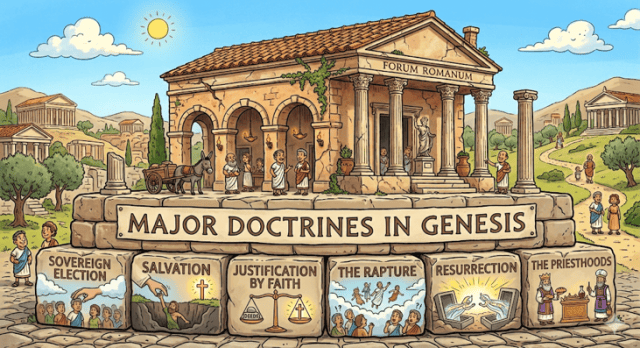
Ever feel like the Christian faith has a lot of massive, intimidating words? We hear terms like “justification,” “election,” and “rapture,” and it can sometimes feel like trying to build a towering structure by starting with the roof. But if you’ve ever watched a building go up, you know you can’t construct something incredible without a rock-solid foundation.
Our faith is exactly like that. Just like a massive stone building rests heavily on foundational blocks, every major Christian doctrine is firmly rooted in the very first book of the Bible. The wild part? The major themes of the New Testament were set up thousands of years earlier in Genesis.
Let’s look at the foundational blocks of our faith and how they connect to real life right now.
1. Sovereign Election (Genesis 4)
The Concept: God is in control and chooses how His story unfolds. The Verse: “Abel also brought of the firstborn of his flock and of their fat. And the LORD respected Abel and his offering…” (Genesis 4:4, NKJV).
Real Life: It’s easy to look at the world, the chaos in your feed, and your own life, and wonder if anyone is at the wheel. In Genesis 4, we see God interacting with Cain and Abel, setting up the reality of Sovereign Election. God’s choice and favor are based on His own perfect will and purpose, not just human logic. It’s a reminder that God has a master plan, and you get to be part of a story He is actively writing.
2. Salvation (Genesis 3)
The Concept: God covers our mess. The Verse: “Also for Adam and his wife the LORD God made tunics of skin, and clothed them.” (Genesis 3:21, NKJV).
Real Life: We all mess up. Adam and Eve literally broke the world and then tried to awkwardly cover their shame with some leaves. Sound familiar? When we make mistakes, we usually try to hide them or fix them ourselves. But the doctrine of Salvation starts right here in Genesis 3:21. God stepped in, made a sacrifice, and gave them real clothing. He covered their shame when they couldn’t. That is the exact same salvation Jesus offers us today.
3. Justification by Faith (Genesis 15)
The Concept: You don’t have to earn it; you just have to believe. The Verse: “And he believed in the LORD, and He accounted it to him for righteousness.” (Genesis 15:6, NKJV).
Real Life: We live in a world obsessed with resumes, grades, and proving our worth. It’s exhausting. But Genesis 15:6 introduces “Justification by faith”. God didn’t ask Abraham to perform a bunch of miracles or be perfect. Abraham simply trusted God, and God stamped his account as “righteous” (good to go). Your relationship with God isn’t based on your performance; it’s based on your trust in Him.
4. The Rapture (Genesis 5)
The Concept: Being caught up with God. The Verse: “And Enoch walked with God; and he was not, for God took him.” (Genesis 5:24, NKJV).
Real Life: The idea of believers one day being caught up to be with God (the Rapture) isn’t just a wild sci-fi concept from Revelation; it’s right there in Genesis 5. Enoch was living in a chaotic, dark world, but he stayed so close to God that one day, God just pulled him out of it entirely. It gives us hope that this broken world isn’t our final destination.
5. Resurrection (Genesis 22)
The Concept: Dead ends aren’t really dead ends. The Verse: “And Abraham said to his young men, ‘Stay here with the donkey; the lad and I will go yonder and worship, and we will come back to you.'” (Genesis 22:5, NKJV).
Real Life: When God asked Abraham to sacrifice his promised son, Isaac, it looked like the ultimate dead end. But notice what Abraham says: “we will come back to you.” Abraham fully believed that even if Isaac died, God would raise him back to life. This Genesis 22 moment points straight to the Resurrection. When you face situations that feel completely hopeless or “dead,” remember that our faith is built on a God who brings things back to life.
6. The Priesthoods (Genesis 14)
The Concept: We have a mediator. The Verse: “Then Melchizedek king of Salem brought out bread and wine; he was the priest of God Most High.” (Genesis 14:18, NKJV).
Real Life: Have you ever needed someone to stand up for you or bridge a gap between you and a teacher or boss? That’s what a priest does between us and God. The foundations for both the Aaronic and Melchizedekian priesthoods are laid out early in Genesis 14. Melchizedek shows up out of nowhere with bread and wine (hello, communion!) to bless Abraham, pointing forward to Jesus, who is our ultimate High Priest fighting for us today.
The Takeaway Next time you read the Bible, don’t just view Genesis as an old history book. It is the blueprint. The entire foundation of what we believe about God, ourselves, and our future is buried right there in the soil of the very first chapters.
But the most important part of this entire blueprint points to one person: Jesus Christ, God’s Son. He is the ultimate fulfillment of these foundations, offering us His free gift of salvation. As John 3:16 reminds us, “For God so loved the world that He gave His only begotten Son, that whoever believes in Him should not perish but have everlasting life.” Stepping into that truth is as simple as trusting Him, because Romans 10:9-10 promises, “that if you confess with your mouth the Lord Jesus and believe in your heart that God has raised Him from the dead, you will be saved. For with the heart one believes unto righteousness, and with the mouth confession is made unto salvation.”
May God Bless you as you seek Him out through His Word and Prayer!
Latest Blog Posts
Stay informed and inspired with our latest blog posts. Discover insights, tips, and trends across various topics.
-

The Digital Harlot: Resisting the Seduction of Modern Babylon
While Babylon was a historical empire, the spirit of Babylon is an ongoing, global matrix…
-

Don’t Bury Your Gifts: Do not waste the Special Talents God has given you!
God has entrusted you with specific gifts, and He expects you to use them to…
-

Lens Check: How Your Worldview Shapes Everything You See
Have you ever stopped to think about why people can look at the exact same…

Leave a Reply